Originally published 07.21.23
“As we’re looking for ways to solve the big picture problems we’re facing with global warming, there are people who’ve lived sustainably within the environment for a long time that we should be asking advice from.” Craig Tucker, Natural Resources Consultant, Karuk Tribe
In many ways, Indigenous knowledge is more encompassing and profound [compared with the limitations of science]. It embraces gratitude, love, respect and a deep sense of responsibility. Scientists scrub such emotions in the name of objectivity and try to find universal principles that can be replicated anywhere…..Both science and Indigenous knowledge are needed for a fuller understanding of our place in the world.”1 – David Suzuki Institute, Reconciling Ways of Knowing
Dear readers,
The consequences of changes to global temperature rise and other environmental disruptions have reached a climax with the latest IPCC release2 causing quite an uproar from climate activists. They are calling for action to be taken now in drastic measures; stating there’s never been a time more urgent for all available knowledge and resources to come together in the fight to save our world from being uninhabitable. [If at all possible] Some of this knowledge and these resources will come from Indigenous peoples who are finding great opportunity to shine during these times.
While a question of debate in times past, the AR6 Synthesis Report3 resounded confidently that irresponsible stewardship of earth on the part of humans is indeed the primary cause for own environmental downfall. While a painful admission, this gives us some ounce of hope for our role in turning the tables of fate. The model of industrialized lifestyle has proven unsustainable for our planet and the value of organic low-carbon footprint4 lifestyles has proven the more sustainable model.
The recognized need for indigenous knowledge has been given increased priority in recent years by the UN, The White House, and among scientific and higher learning communities for the purpose of understanding and combating climate change. But Indigenous people are concerned about more than just reversing the irresponsible mess that’s been made. They care about the whole approach to a more harmonious & conscious way of living for more than just our generation, as do many activists, so this is a great way to find common ground that will build a better future for all.
IPCC Reference:
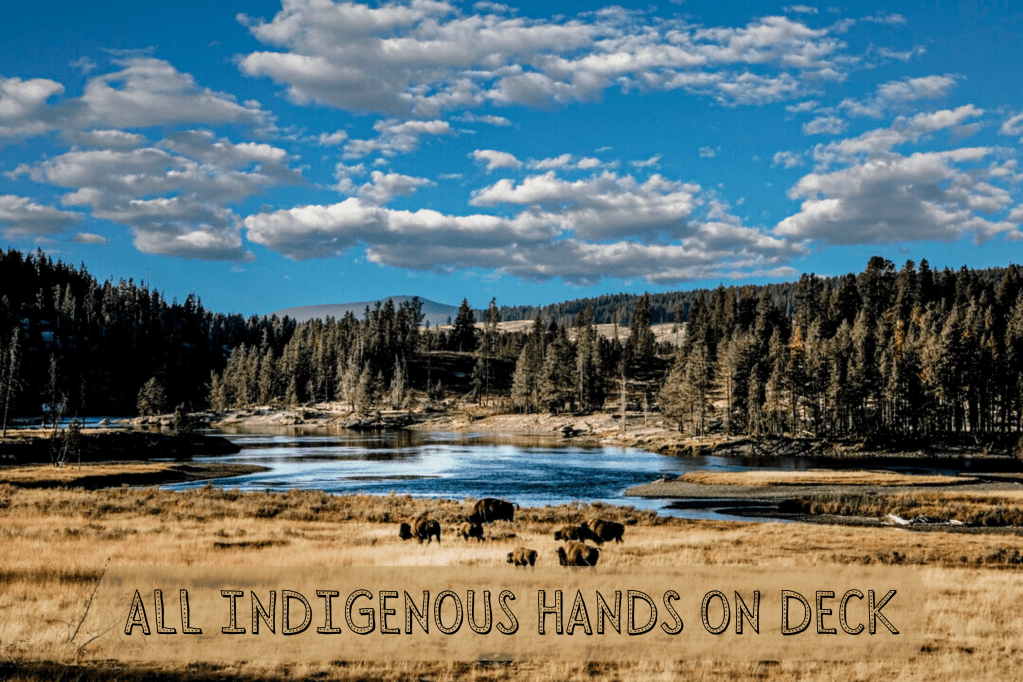
https://www.ipcc.ch/srccl/faqs/faqs-chapter-7/: All Indigenous Hands On Deck“Indigenous peoples’ and local community lands cover a third of the earth’s territories. The fact that 91% of them are in good or fair ecological condition today is a testament to the effectiveness of long-term Indigenous stewardship in managing complex natural environments.” – World Economic Forum5
“At the White House Tribal Nations Summit in November 2021, the White House Office of Science and Technology Policy (OSTP) and the White House Council on Environmental Quality (CEQ) issued a memorandum recognizing the importance of Indigenous Knowledge and committing to elevating its role in federal scientific and policy processes and creating an interagency working group to develop government-wide guidance.”6
Personal Insight: Forgive my excitement during such a grave time, but I have to admit, I’ve been pleasantly surprised over the past year as a journalist, to see my ambitions for Indigenous knowledge already at the forefront of major news, even if still not widely embraced or understood (and don’t worry, I’m still in the process myself). One of the primary goals I’ve had in creating my journal has been to share with the world the need for recognizing the value of indigenous ways and practices in regard to earthly stewardship and as models of alternative living in light of the climate change crisis, but also … just because it’s a good way of life: to live more holistically-minded, spiritually connected, and living closer to the land; considerate of all creations inter-workings with each other; able to see direct observations and effects; having greater bonds with all areas of life.
I thought this would be one of the hardest challenges I would face to try and convince others of this revelation, but I see now that the tide has already turned in my favor and much work has already been done by others to bridge this gap between depending on science and depending on observational practice. I’m a nobody from nowhere, but I’ve seen enough to make me want to speak out and use my voice to try and change the attitudes many people have toward indigenous lifestyles; primarily being, “that kind of outdated lifestyle is not for us and is holding progress back.” These lifestyles are now being given due respect as more sustainable to our environment and hopefully one day, as overall well-being for our spiritual, mental, and physical states.
More Than Science
Indigenous knowledge and observations can contribute to greater comprehension and application in ways that are different from the scientific approach.
Science can show us the data for how a conservation park reduces greenhouse gases, but indigenous knowledge can guide us in how to preserve the parks for future generations to come.
In California, some reversal has been made to give more credit to indigenous people’s knowledge of land stewardship through controlled burning, a cultural practice banned in previous times. In Alaska, tribes have worked with climate scientists to discover the effects of climate change that result in benefiting both parties seeing the bigger picture. In Africa, India, Australia, China and elsewhere, local people with traditional ecological knowledge are helping governments transform the knowledge-base platform and providing valuable insight for adaptive practices that restore local sustainability with greater applications for larger projects.
TEK & Place-Based Learning Communities
TEK or Traditional Ecological Knowledge is a term that’s come into use to describe the inter-relational role of peoples to the land and environment around them. Place-based learning is structured around the valuable knowledge or wisdom that can be gained from area-specific understanding. These are basic definitions as different viewpoints or opinions are formed by those holding the term; it’s best to keep an open-mind approach to these terms when being used.
Quotes from various sources:
The National Park Service defines TEK as:
“The on-going accumulation of knowledge, practice and belief about relationships between living beings in a specific ecosystem that is acquired by indigenous people over hundreds or thousands of years through direct contact with the environment, handed down through generations, and used for life-sustaining ways.
This knowledge includes the relationships between people, plants, animals, natural phenomena, landscapes, and timing of events for activities such as hunting, fishing, trapping, agriculture, and forestry. It encompasses the world view of a people, which includes ecology, spirituality, human and animal relationships, and more.”
“Indigenous peoples as well as non-Indigenous peoples who are long-term (hundreds of years) local residents, e.g., Appalachian communities, Spanish land grant communities, can also provide TEK”
-Synopsis of Traditional Ecological Knowledge, National Park Service7
Highlights from Humboldt College of Natural Resources & Sciences8 informational video:
(I highly recommend watching the full short-film found on their YT channel – click here)
“Traditional knowledge is knowledge that we’ve gained over thousands of years through observation and through practicing, through this kind of adaptive management process. And if a certain way didn’t work: then let’s try another way next year, and make sure we pass that information along to our kids and grand-kids, so that [it] stays with our community as ‘this is the way that works’.” Craig Tucker
“Sometimes scientists are too quick to assume that the best way to conserve nature is to keep people out, and that approach doesn’t recognize the integral nature between human communities and their ecosystems. Tribal communities … their whole worldview really emphasizes the integral role of people in the ecosystem and they acknowledge that human well-being really depends on maintaining some kind of a reciprocal relationship with nature, and when you have that recognition that kind of changes the conversation from kind of an old-school view of conservation and that is “how do we protect nature from people” to a much more open conversation about how do we conserve nature for people.”
UNESCO
“panelist, Dr. Joseph Karanja, Associate Project Officer of the LINKS Section of UNESCO Natural Sciences Sector presented on linking ILK with science. He said that while [some] Indigenous People may not be able to read or write, they have a deep knowledge about ecosystems that is less studied by science and can be traced back centuries: “Indigenous Peoples and local communities are one of the most eco-literate and adaptive human beings”.” 9
“There are more than 350 million Indigenous People worldwide who mostly depend on the environment for sustenance and who face severe impacts of climate change due to the nature of their locality i.e. high-risk environments; unpredictable and variable weather conditions. It is therefore necessary to identify and recognize the uniqueness of Indigenous knowledge and its potential in enriching the understanding of the environment and disaster management.”10
Indigenous ways are bound with the land that supports them
Indigenous people are found all over the world holding fast to some of the most antiquated customs and traditions. Each successive generation has handed down what the previous generation of elders kept and carefully guarded in their efforts to preserve the tried and true ways of being. Many of these customs and traditions are weaved into fabric, painted on clay pots, or hidden in rituals and dances. Their knowledge is not just studied in books and recitations but is learned through everyday activities and life itself.
A child learns to honor nature when they spend the majority of their time there, exploring the mysteries of the wind and rain, the curious beetle and poison ivy; encountering wild animals and gazing upon untiring beauty in the landscapes. An older boy understands he needs a fire to keep warm and be able to cook the gains of his hunting. A girl knows she must learn the ways of her mother if she wants to survive to one day bear her own children; the right types of berries to eat or use for dye, where to find the materials for making clothing and where to find clean water.
For many indigenous peoples, there is no separation between their natural environment and daily life. So, they hold vast amounts of knowledge of their environmental surroundings, sometimes without even realizing it, but very often intentionally and consciously. They make effort to preserve the land, air, sea and creatures that give so much to them and being very aware of the significance to their own well-being, vow to give back in return.
Non-indigenous Peoples
Non-indigenous peoples who live predominantly dependent on others providing most of their goods, (food, clothing, shelter, means of entertainment, and so on) can have a more difficult time appreciating the resources for those goods or comprehending the consequences of their actions in relation to consumption. One can buy fast food or enjoy fine dining without seeing the animal lose its life or care for how its raised and treated or where the waste goes after. One can buy lumber or wooden furniture without seeing the trees cut down or how the forest life is affected.
This makes it more difficult for those who are emotionally inclined to be sensitive to the needs of the greater workings of nature to be able to have a clear picture of what’s happening outside of their cubicle, apartment building, or townhouse. By raising awareness of the role indigenous people play in our environment we can build more appreciation for relationships that seek to restore balance to the disorder we are seeing socially & environmentally by their historical commitment to the same.
Call to action:
- If you are someone who has indigenous knowledge that you would like to share with the world, please see the following article for a list of organizations ready to receive your voice.
- If you are someone who is connected with tribes or groups with TEK, please help make them aware of efforts to increase learning, understanding and relationships that can help bridge the gaps missing in the scientific community.
- If you have more resources for connecting indigenous knowledge groups with those in need of their input, please share them here or in the comments of the following link.
Resource List for Indigenous Traditional Ecological Knowledge Exchange
- If you found this article helpful and would like to stay informed of related content, you can subscribe to this newsletter and/or post in the comments section at the end of this article. If you will, please share what you found most helpful, interesting and/or what you would like to see covered more in future articles. Your input is greatly appreciated!
- If you have related stories, I would love to hear them! Please consider sharing with the journal for potential coverage.
“We are now in very precarious times. Global warming. The rivers the lakes are now sick . . . How to take care of mother earth. What are the secrets of life that we should always have in our hearts and minds to acknowledge the life cycle. All our traditional teachings of the Native American /people/ are now greatly needed. How to be in balance in the world, with life and creation, and what we can give to the world society of our teachings . . . We don’t have much time to smarten up.”11 -Mike Mitchell
With all of our technological advancements failing to prevent a doomsday scenario, it may be time to rethink the value of past societies’ time-honored ways and humble ourselves to admit that…
“Understanding the way of the buffalo is no less important than understanding the way of AI.” – FB
Reporting,
iam:ForeverBlessed
Thank you for supporting independent journalism.
Disclaimer: Please forgive any mistakes in grammar or punctuation as I continue furthering my education in language arts, and thank you for your understanding.
1https://www.davidsuzukiinstitute.ca/reconciling-ways-of-knowing
2https://www.ipcc.ch/report/ar6/syr/
3https://www.ipcc.ch/report/sixth-assessment-report-cycle/
4https://vitality.io/the-many-benefits-of-reducing-carbon-footprint/#:~:text=Simply%20put%2C%20your%20carbon%20footprint,help%20mitigate%20the%20climate%20crisis.
5https://www.weforum.org/reports/embedding-indigenous-knowledge-in-the-conservation-and-restoration-of-landscapes/
6https://www.bia.gov/service/tribal-consultations/departmental-policy-indigenous-knowledge
7https://www.nps.gov/subjects/tek/description.htm#:~:text=Traditional%20Ecological%20Knowledge%20(TEK)%20is,environment%2C%20handed%20down%20through%20generations%2C
8https://cnrs.humboldt.edu/learning-communities
9https://www.unesco.org/en/articles/unesco-calls-recognizing-african-indigenous-knowledge-disaster-management
10https://www.unesco.org/en/articles/unesco-calls-recognizing-african-indigenous-knowledge-disaster-management


What’s your angle and perspective?