Timucuan | Timucua | Timucuan Ecological and Historical Preserve | National Park Service | US History | Spanish-Florida History | Jacksonville History | Kingsley Plantation | Slavery | Freedom | Influential Women | Agriculture | Timucuan Agriculture | Indigenous Knowledge | Fort Caroline | Controversial Sites | Misinformation | Fact Finding | On-going Research | Excavations | Archaeology | Curiosity | Research |
{Informative}
Part I – Timucuan Preserve History
- Kingsley Plantation – Anna Kingsley
- Native Timucuan People and Newly Discovered Sarabay Settlement
- Fort Caroline – Fake News?
Part II – Timucuan Preserve Ecology (separate article coming soon)
Did you know that Florida’s Fort Caroline has been called a scam? Did you know that a freed African slave woman in America was given full charge of the Kingsley plantation as wife of the owner? Did you know some of the oldest pottery in America was found in the Timucuan Preserve, and that in recent years new evidence of the Mocama tribe’s lost village of Sarabay may have been excavated? While there is much history to be told beyond these questions, my article will focus on these.
We recently visited some of the sites in the Timucuan Ecological and Historical Preserve in Northeast Florida (Read here). What started as a fairly mundane trip has led to more interesting finds: A great controversy as to the location of Fort Caroline, a post-freed female slave in charge of Kingsley Plantation and new discoveries of Indigenous Timucuan people’s existence in the Jacksonville area.
The Timucuan Ecological and Historical Preserve is a place to remember the past through visiting historical sites and walking trails, but is also a place to be actively present in stewarding the history and ecology of the area. It covers a large area of coastal wetlands off the Atlantic coast: 46,000 acres, in fact, of wetlands, waterways, and other habitats in northeastern Duval County. Named for the first native inhabitants to the land, the Timucua, specifically the Mocama tribe, are now a memory, but their previous presence dated back to at least 2500-3000BC according to archaeological research. (Ref)
::Timucuan History::
>>>> The Kingsley Plantation – Anna Kingsley <<<<
Site Location:
11676 Palmetto Ave, Jacksonville, FL, USA 32226
The Timucuan Preserve preserves the former Kingsley Plantation, said to be the oldest remaining slave plantation in Florida. Here, then owner Zephaniah Kingsley (1765 – 1843) obtained land in Spanish-held Florida and established four1 plantations to capitalize on conquests of “The New World.” Born of a Quaker family in Bristol, England and raised by them in Charleston, South Carolina, he eventually ventured out on his own becoming a merchant slave-trader and lived at Kingsley Plantation for 25 years where he grew oranges, potatoes, peas, corn and Sea Island cotton. He would casually change nationalities2 and religions to best suit his lifestyle habits, later dying and being buried in New York with Haitian nationality.
See also: Adjacent land history of Orange Park/Laurel Grove
“Kingsley stood alone among Southern statesmen in maintaining that Blacks were just as intelligent as whites. He ridiculed racism, observing that “color ought not to be the base of degradation.” In Kingsley’s opinion, “the colored race” was “superior to us, physically and morally. They are more healthy, have more graceful forms, softer skin, and sweeter voices. They are more docile and affectionate, more faithful in their attachments, and less prone to mischief, than the white race. If it were not so, they could not have been kept in slavery.””3
“He was a relatively lenient slaveholder who respected slave families and allowed his enslaved a freedom not routine: the opportunity to hire themselves out when their work was completed, and eventually purchase their freedom for 50% of their market value.”4
Zephaniah Kingsley stands out not just for being the main historical figure of the Kingsley plantation, but because he married Anna Kingsley. The child Anna was purchased by the slave trader at a slave auction in Cuba specifically to be his wife. She was originally from Senegal West Africa. She was one of four wives and she lived in the house with Zephaniah. She would come to run the plantation in Zephaniah’s absence -unheard of for a black woman at that time.
Anna Madgigine Jai Kingsley was born June 1793 and died July 1870. Although she was born as Princess Anta Madjiguène Ndiaye (Alt names) of the Wolof people, she lived most of her childhood as a slave after being captured and presumably sent to Cuba at age 13. “Celebrated and solemnized by her native African custom,”5 (supposedly) she was married to Zephaniah (age 43), becoming Anna Kingsley. She became pregnant soon after and altogether they had four bi-racial children.
At age 18 (in 1811), her husband officially freed her through legal manumission and made her governess over his East Florida plantations6. Other accounts say Zephaniah was seeking a wife in Africa and fabricated the story of her slavery to give more credibility to her status as a truly free woman.7 She was given a Spanish land grant of 5 acres and owned 12 slaves. Because Florida was under Spanish law at this time and slavery was common, not necessarily due to race or genetic factors, slaves were encouraged to buy their freedom. While Anna was herself once a slave, she also owned slaves who were working towards their freedom to be let go.8 After defending her property against rival Americans she was rewarded an additional grant of 350 acres by the Spanish government.
Still, the early forming U.S. won the state of Florida and discriminatory laws against bi-racial marriage caused the Kingsley family to flee to Haiti9. After Zephaniah’s death, Anna returned to Florida to win a court case (against her husband’s white relatives) proving her rights to inheritance. Even during such racially tumultuous times, she was able to find favor with the courts. She became a planter and slave owner in her own right. (This dispels some of the ideas that slaves could rise to power, but it was still rare in that time.)
All of the structures on today’s modern site are original except for the addition of two rooms on the main house. There’s a separate barn and store house as well as a semi-circle of tabby houses that served as slave quarters. You can read more about our trip to Kingsley Plantation and see pictures of the sites by clicking here
>>>> Native Timucuan People and Newly Discovered Sarabay Settlement <<<<
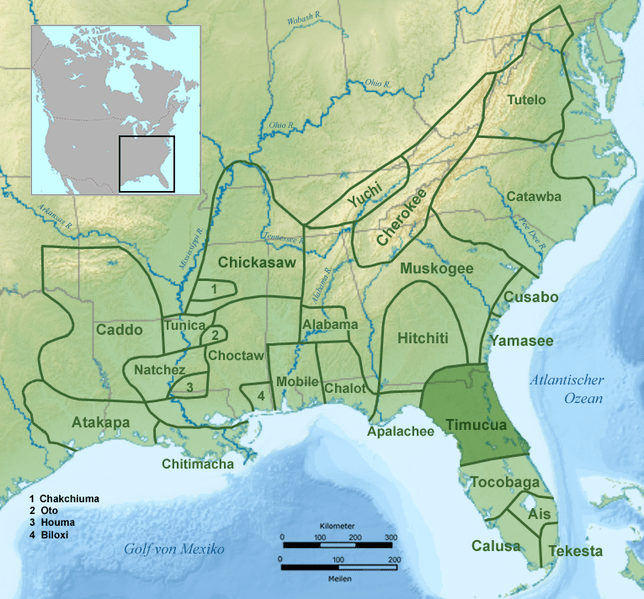
Timucua (or Timucuan) is a broad name used to describe the historical Indigenous group of Timucua-speaking people who covered a large geographical area from Northeastern Florida to a sliver of Southeastern Georgia. There are believed to have been more than 15 individual tribes within this group who had their own political systems, including some who were rivals to each other.
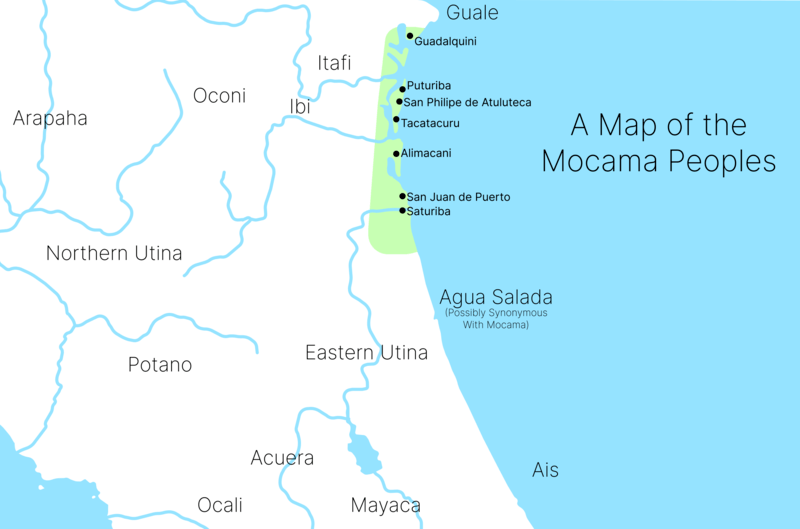
They were encountered by Spanish missionaries who lived among them during the late 1500’s to early 1600’s. At the same time French colonists were founding Fort Caroline. According to French Huguenots, two major Mocama chiefdoms dominated the area at the time of European contact, the Saturiwa and the Tacatacuru, each of which demonstrated authority over multiple villages. The Mocama were a distinct group that lived along the coast, from south of the St. Johns River, FL to St. Simons Island, GA, now known as Mocama Province (map below) and would have been the tribe living in the area of Jacksonville’s modern borders for Timucuan Preserve.1011
The people were named for their lifestyles, engulfed by the maritime environment, Mocama being roughly translated to mean “of the sea.”12 They were people of the sea and were believed to have large networks of trading routes in the intra-coastal and coastal areas. For example, copper found among them was believed to have come from the Appalachian Mountains.13
Mocama Province
Timucua Agriculture
While the Mocama were known as being sea-faring coastal people who fished, hunted and gathered; the Timucua in general were agricultural tribes staying in the same places, unlike many other Florida tribes. They were semi-nomadic during colder months and grew crops that preserved them for about half of the year at a time. Besides the “three sisters” (maize, beans and squash), pumpkins, cucumbers, peas, and gourds were some of the crops they favored. Other fruits, starches and roots were gathered as well, along with hickory nuts, berries, and acorns and food that “the French did not recognize.”14 15
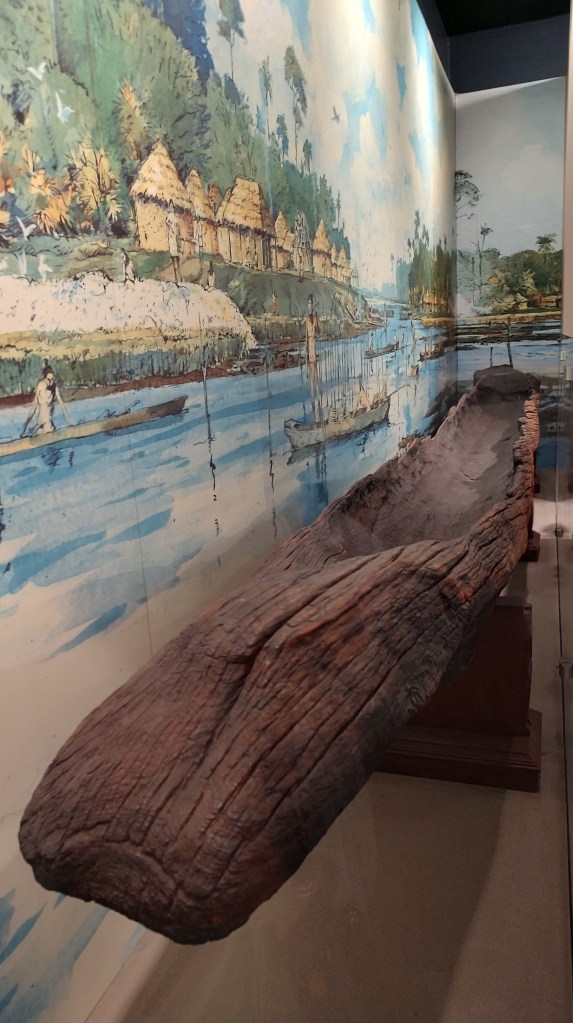
They also hunted alligator, deer, bear, turkey and such. Fish and seafood were a primary source of food. They used dug-out canoes to tread the waters around them. Middens, or oyster shell mounds are commonly found along the coastlines, across Florida (and for fun, even worldwide along seacoasts by various nationalities).
A picture taken on our visit at the Fort Caroline Memorial site.
“They be all naked and of goodly stature, mighty, faire and as well shapen…as any people in all the worlde, very gentill, curtious and of good nature… the men be of tawny color, hawke nosed and of a pleasant countenance…the women be well favored and modest…” – French explorer Jean Ribault16
Sadly, while both Europeans and Native Americans suffered from transmitting new diseases to each other, most of the indigenous people were wiped out completely. There’s also a history of violence associated with their “disappearance.” However, since some of the remaining tribes moved and merged into other Florida tribes there could still be those alive today with Timucuan ancestry.
Today, archaeologists and historians are trying to give them a new voice in the present day. Professor Keith Ashley, head of UNF Archaeology Lab, hopes to broaden the lens of viewing the Indigenous Timucua people from their own perspectives, not just as though looking “over the shoulder” of Europeans.
Sarabay Archaeology Project:
Sarabay settlement is mentioned in French and Spanish documents dating back to the 1560’s, but has never been discovered. Now, there’s very strong evidence to believe what’s being unearthed on Big Talbot Island State Park in Jacksonville, Florida is the lost Sarabay town. The University of North Florida has a dedicated mission to the Mocama Archaeology Project and Sarabay Project which aims to locate villages that help rebuild the social landscape of the 16th century as well as finding clues that lead to understanding of 16-17th century European contact.
The excavations have proved useful in finding a collection of Spanish pottery, locally produced pottery, and items made from bone, stone, and shell, in addition to fragments of burned corn cobs.17, jewelry beads and other artifacts.
UNF’s archaeologist Keith Ashley continues to lead the excavation projects that he began in 1998 to present. The Sarabay Project’s excavations have exposed poles believed to be from a native council house, pits, hearths, activity areas and more still to be discovered, the site now known as Armellino.
““No doubt we have a 16th-century Mocama community,” dig leader Keith Ashley tells the Times-Union. “This is not just some little camp area. This is a major settlement, a major community.”” – reported by Smithsonian Magazine online18
Further Digging :
This is a video from 3 years ago capturing digs at the excavation site on Big Talbot Island.
And a news reel with Professor Ashely showing some of pieces uncovered on the site:
(2021)
ResearchGate.net pub Excavation at Armellino
Indigenous Jacksonville 10,000+ Years of History:
>>>> Fort Caroline – Fake News??? <<<<
Off the edge of St. John’s River in Jacksonville, Florida sits Fort Caroline National Memorial. To the unwise visitor (myself included), it might not be obvious that the Fort is a memorial of the original, not the actual. It explains a lot now after racking my brain trying to figure out why it was so small and imaging how soldiers could have possibly defended themselves (almost embarrassing now). It wasn’t until dutifully doing my research for what I thought would be a quick, sweet article that I came across an unhappy soul’s complaints about the scam of Fort Caroline.
Here’s what I found from Architect Richard Thornton’s dedicated page to the cause…
While on a camping trip at Cumberland Island, GA (just north along the coast above Florida), he and some friends stayed for two weeks looking for evidence of colonial history. They found a wooden sign indicating French and Spanish occupation, but years later it had been removed.
“We didn’t know the connection to Fort Caroline. In fact, I had never heard of Fort Caroline at that point in my life. The sign was still there, but barely legible, in November 1999, when I was camping on the island with a teacher from Rome, GA. The sign was gone in June 2006, when I was visiting Cumberland with a lady friend from Canada. Back in the early 20th century, Georgians knew the real location of Fort Caroline, but by the late 20th century, people assumed that Fort Caroline was in Jacksonville…because the professors and National Park Service said so!” (Ref article)
So, maybe he’s wrong… But, after much research, no one in Jacksonville seems to be vehemently rejecting the claims, except maybe a few hot-heads on an online forum I found. But publicly, the Fort Caroline National Memorial run by the National Park Service and the UNF Archaeological Lab admits that the fort is, in fact, a replica and takes the position that the exact location remains unknown.
From UNF Archaeological Lab:
“One of the most iconic features of the modern Jacksonville landscape is Fort Caroline. This National Park Service (NPS) memorial honors the first French settlement (La Caroline) in North America (1564-1565). Following its downfall at the hands of the Spanish, the fort became the scene of a Spanish garrison known as San Mateo (1565-1569). Although today’s replica of Fort Caroline receives thousands of visitors (including out-of-state tourists) a year, currently no material evidence has been found relating to the French colony of La Caroline or the later Spanish fort. Colonial documents concerning the forts, however, do exist and point to its location within the broader Ft. Caroline area of modern Jacksonville. With the 450th anniversary of the La Caroline Colony fast approaching, the Archaeology Lab at the University of North Florida (UNF) received a State of Florida Historical Resources Matching Grant to undertake a systematic archaeological search for evidence of these two historic landmarks. Working primarily along the south bank of the St. Johns River, lab personnel have dug over 600 shovel tests examining a varied of areas for evidence of the French and Spanish occupation. The French and Spanish Forts represent a significant establishment of European contact in the middle of the Mocama, Timcucuan, and the natives who greeted the French.
A primary intent of the present investigation was to intensively survey these several project loci in search of evidence for the La Caroline colony (1564-1565) or the later Spanish Fort of San Mateo (1565-1569), which occupied the same spot of Fort Caroline. The search for La Caroline is part of the University of North Florida’s broader Mocama Archaeological Project (MAP), a collaborative, multidisciplinary research program that combines archaeological survey, excavation, and standardized and specialized analysis; GIS mapping; and documentary and archival research. It is committed to the search for Mocama Indian villages and European colonial communities in order to reconstruct the sixteenth century social landscape of northeastern Florida.” [end quote]
So there you have it. A mystery unsolved… but, maybe not in the minds of everyone.
“Several French historians contacted me to tell me that they have always known that Fort Caroline was in present-day Georgia. They never understood why the US Government built an inaccurate 1/12th model of Fort Caroline in Jacksonville, FL. The real Fort Caroline was built to hold at least 1000 colonists!”19
Web Quotes:
“The San Pedro de Mocama mission, located on Cumberland Island, Georgia, was the principal Spanish mission of the Mocama-speaking Timucua Indians from 1587 to the early 1660s.” – NPS History (PDF Ref)
“French explorers sailed into the St. Johns in 1562. And as his men set up a stone marker claiming the Mocama land for France, the natives greeted them “with gentleness and kindness,” wrote Capt. Jean Ribault.”…[many would die and] By 1710, observers said that northeastern Florida was basically empty of human life. There was little left but those saltwater estuaries where the Mocama had lived for so long.20
“The Europeans went off a short distance and knelt down, offering a prayer of thanks for a safe arrival. This proved to be the first Protestant prayer that was said within the limits of the present-day United States. [Captain] Ribault and his accomplices were Protestant Huguenots who came to America for religious freedom. They tried to find refuge from the anti-Protestant rage that swept their homeland.” – Jaxhistory.org21
“FORT CAROLINE BY A NOSE — Who were the first Europeans to settle in Florida? In 1565, the Spanish founded their famous town, St. Augustine. One year before, however, the French established Fort Caroline near St. Johns Bluff. This stronghold stood on the St. Johns River, about mid-way between the Atlantic Ocean and present-day downtown Jacksonville. In fact, Fort Caroline proved to be the first Protestant settlement in North America.”22 – Jax History.org
You can follow this link to a 400-year-old drawing of the original Fort from JaxHistory.org
In any case, the replica Fort Caroline memorial in Jacksonville, Florida still serves to draw attention to education we might not otherwise know about. Something happened somewhere over here along the “first coast” and it’s great to see the honest efforts going into fact-checking so that we can tell more accurate stories and have a better understanding of the past that is still influential to our lives.
Well, if there’s anything I’ve learned from researching, history, archaeology, and story telling, it’s that there’s rarely one side of the story and even more rarely a complete narrative…and maybe that’s not such a bad thing. Otherwise we might get too comfortable never being challenged by our notions of reality and blindly accept anything we hear at face value.
So, keep telling the stories from your own angle and perspective, keep an open mind when looking for the truth, keep exploring, stay curious, research diligently, and always lend an ear to new ideas… and take everything I say with a grain of salt. New evidence or knowledge may change the future story. 🙂
Dedicatedly searching for the truth,
iam:ForeverBlessed

1https://en.wikipedia.org/wiki/Zephaniah_Kingsley#:~:text=St.%20Johns%20Bluff%2C%20San%20Jose%2C%20and%20Beauclerc%20in%20what%20is%20now%20Jacksonville%2C%20and%20Drayton%20Island%20farther%20south%20near%20Lake%20George.%5B4%5D
2https://en.wikipedia.org/wiki/Zephaniah_Kingsley#:~:text=Kingsley%20casually%20changed%20nationalities
3https://en.wikipedia.org/wiki/Zephaniah_Kingsley#:~:text=Kingsley%20stood%20alone%20among%20Southern
4https://en.wikipedia.org/wiki/Zephaniah_Kingsley#:~:text=He%20was%20a%20relatively%20lenient%20slaveholder
5https://en.wikipedia.org/wiki/Anna_Madgigine_Jai_Kingsley#:~:text=%22celebrated%20and%20solemnized%20by%20her%20native%20African%20custom.%22
6https://en.wikipedia.org/wiki/Anna_Madgigine_Jai_Kingsley#:~:text=gave%20her%20responsibilities%20for%20his%20plantations%20in%20East%20Florida
7https://en.wikipedia.org/wiki/Anna_Madgigine_Jai_Kingsley#:~:text=enslaved%2C%20for%20his-,manumission,-to%20be%20valid
8https://www.youtube.com/watch?v=6W8d-DkowLk
9https://en.wikipedia.org/wiki/Anna_Madgigine_Jai_Kingsley#:~:text=After%20the%20United,Historic%20Preserve.
10https://www.jacksonville.com/story/lifestyle/2009/10/18/the-mocama-new-name-for-an-old-people/15969845007/#:~:text=For%20years%2C%20they%27ve,as%20the%20Mocama.
11https://www.researchgate.net/figure/Mocama-Province-including-mission-locations_fig1_304497322
12https://www.jacksonville.com/story/lifestyle/2009/10/18/the-mocama-new-name-for-an-old-people/15969845007/
13https://en.wikipedia.org/wiki/Appalachian_Mountains
14https://www.nps.gov/timu/learn/timuwaysoflife.htm
15https://www.legendsofamerica.com/fl-timucuatribe/
16https://www.legendsofamerica.com/fl-timucuatribe/#:~:text=%E2%80%9CThey%20be%20all,explorer%20Jean%20Ribault
17https://www.archaeology.org/news/9743-210609-florida-sarabay-contact
18https://www.smithsonianmag.com/smart-news/researchers-may-have-rediscovered-long-lost-indigenous-settlement-florida-1-180977973/
191794 map proves that Fort Caroline was located in present-day Georgia! – The Americas Revealed (apalacheresearch.com)
20https://www.jacksonville.com/story/lifestyle/2009/10/18/stub-91/15969824007/#:~:text=French%20explorers%20sailed%20into%20the%20St.%20Johns%20in%201562.%20And%20as%20his%20men%20set%20up%20a%20stone%20marker%20claiming%20the%20Mocama%20land%20for%20France%2C%20the%20natives%20greeted%20them%20%22with%20gentleness%20and%20kindness%2C%22%20wrote%20Capt.%20Jean%20Ribault.
21https://www.jaxhistory.org/portfolio-items/fort-caroline/
22https://www.jaxhistory.org/portfolio-items/fort-caroline/
https://www.metrojacksonville.com/forum/index.php?topic=20868.15
https://www.nps.gov/timu/learn/historyculture/timu-society.htm

 Angle & Perspective
Leave a reply to Timucuan Preserve: Ecology & Preservation with tributes to SASMI & Gullah Geechee Nation – Angle & Perspective Cancel reply