| Journalism | Journalists | Opinion | Struggles | Challenges | Free Speech | Media | Mainstream Media | Credibility | Integrity | Reputation | Trust | Trustworthiness | Public Opinion | Public Scrutiny | Authority | Truth | Accountability | Responsibility | Society | Internet | AI | Public Figures | Information | Infowars | Checks and Balances | Storytelling | Fact-checking | Perspectives | Democracy |
Does the credibility of journalists lie only on their own backs or does it require a larger role to be played by society?
Journalists have taken a lot of heat in recent years, especially those who by default, have been associated with big name media companies. The public struggles to trust modern journalism, and yet, what is the alternative?
Credibility requires not just the informer to be right, accurate and truthful, but it also requires the informed -the listener, hearer, to be truthful with themselves as well; to be rational, objectional and, when necessary, reflective enough to backtrack their stance or move forward with a more informed perspective.
It also requires the admission on both sides, when necessary, to be in the vulnerable space of actually not knowing and being humble enough to admit it, as well as to admit that they could be missing some vital information or that they’re simply just trusting someone they want to believe in.
Most of them time, we are all just moving along with the information we have available to us, as sometimes decisions and positions require us to make a stance even when we’re not completely sure or don’t have all of the information available that would lend to more sound judgment or better action.
In my opinion, journalism is not as concrete of a practice as we’ve previously been led to believe, even before “info wars” became a popularized issue.
Journalism is simply telling stories from a certain perspective. When the national perspective is generally agreed upon across the board, there’s really little to no need to challenge the story-tellers or story-telling or credibility of the system by which it stands since we all *generally* have the same expectations, even around conflict and how we deal with it.
It’s when the national perspective is no longer united and expectations become divided that journalism takes more heat, because in the same way that two people having a divided conversation might disagree with no resolve, journalists also are just telling stories from the divided line, and are sometimes dismissed for even just covering a conversation or topic or event that brings offense.
In other words, as long as people are in debate about whether their truth is more worthy than someone else’s, what is morally right or wrong, there’s going to be the same sort of divide nationally and journalistically as people of different value systems will flock to the journals who cover their preferred perspectives and positions and values.
For some time, it was understood what could and could not be talked about in the mainstream. Everyone knew what they could expect when they turned on the TV to watch the news. Now, everything is being brought to the table to be challenged, to be debated, to be scrutinized, because the entire societal climate has changed. Now when you turn on the news, you’re much more likely to be shocked and surprised by what you see, hear and are compelled to form an opinion on.
People are surprised by the positions of national leaders, companies and organizations and the voice of the people has become an occasion for demanding accountability and change and simply for a chance to be heard, no matter how contrary or seemingly insignificant. (Hey, hey!)
People are also getting new information from new sources. Alex Jones1 2 , from InfoWars became one of the most popular alternative news sources in America via the internet, aka the world wide web, and was able to become successful largely in part due to his online audience. He exposed corruption in American politics and challenged the mainstream media by giving his audience new information that they believed valuable and built an audience heralded as “for the people” and against “the globalists”.
Jones was dismissed as simply an over-hyped conspiracy theorist by the mainstream media, who possibly lost their chance to address his initial claims and be openly transparent with the public, while his audience continued to grow ‘underground’. His hit documentary EndGame released in 2007 exposed elite secret meetings of the the Bilderberg group.3 He popularized the idea of fake news before Trump made it a viral term.4
“Donald Trump has called journalists and news outlets “fake news” nearly 2,000 times since the beginning of his presidency, averaging more than one daily broadside against the press over the last four years.” – The Independent5 , Ref6
“Alex Jones is the most polarizing figure in this nation.” – HBO, The Truth vs. Alex Jones7
“Infowars was thought of as a fringe organization, but at its height, more people were watching [it] than CNN.” – HBO, The Truth vs. Alex Jones8
So it’s not just the mainstream media that’s being challenged and dismantled, it’s the societal notion of what truth is and how to get to it when the people believed to have been stewarding it maybe had fallen asleep at the wheel, not been super diligent or in some cases were just too cowardly to take a stand that put them at odds with the rest of the media outlets narratives… and maybe not all of them.
And maybe it’s not all journalists fault anyway. Technology has given us the potential to move faster than anyone can hope to keep up with. In just a few short years after Alex Jones, we are now facing a new threat to our perception of reality and a war on truth and information thanks to AI (Artificial Intelligence) going mainstream.9
How To Tell Reality From Fiction Amid The AI-Driven Truth Crisis – Forbes
How AI Threatens Democracy – Journal of Democracy
AI And Its Distortion of Reality – OpenFox.com
During a time when truth was already becoming more difficult to discern and distribute, now we have what some see as a potentially impossible-to-correct unleashing of unguided super-intelligence capable of falsifying anything and everything on the web. Mix that with everyone on earth being capable of using social media and AI and you have our modern situation…
Can journalists really be blamed for all that?
At the end of the day, who’s really running this show may be all of us or maybe none of us …and maybe, deep down, that’s what scares us the most.
Maybe journalists are just in the lime light of all the turmoil and unrest that manifests as a result of all humanity’s insecurities and fears and hopes and dreams.
Maybe…
But again, this is just an opinion piece… Right? 😉
My final thought:
If journalists seek to be credible, they must be born out of a society that values credibility, not just in word, but in personal action, for it is this society that bears the responsibility of keeping the checks and balances of those in positions of authority and credibility in line, and vice versa.
The public can’t demand journalists be more credible while at the same time being lazy to know what the truth is or dismissing journalists when they actually tell the truth just because it doesn’t suit them, or just because they don’t like the story the way it actually happened or just because it’s told from a perspective they don’t agree with.
A safe space must be created for journalists to do their work without fear of undue backlash, wasted efforts, of being silenced or even disappearing.
They also can’t be given more authority than is humanly possible to carry. When an event has just happened and all the facts aren’t even in yet, they can’t be held responsible for being expected to speak as if they have all the facts, nor should they pretend they do when they don’t. Truth most often takes time.
As the famous saying goes…
“A lie can travel halfway around the world while the truth is still putting its pants on.” – Mark Twain (or was it…?)10
This is why I’m always open to hearing new angles and perspectives from anyone reading my works as I hope to learn as much as I give. I can share what I think is most shareworthy, but I also have to listen to what my readers think is most important and my writing has to be balanced out with how willing my audience is to listen to what I’m willing to write about. Everything is give and take on both sides. Always.
So, now that I’ve shared my Angle and Perspective, please let me hear yours by sharing in the comments below or you can writeme@angleandperspective.com! Thanks for reading! Please share this article with someone you know and help me reach a wider audience!
The above article was written impromptu after reflecting on the following quotes from Ted Conover in my Journalism coursework:
“The job of a journalist, just a few years ago, was to weigh the views on one side of an issue against the views of people on another side of an issue. And you were fair if you consulted both of them equally. What’s happened to journalism lately is that mainstream journalists (of which I am one) have come to believe that certain statements made by our most recent president, for example, were not true.
For example, the statement that the election was stolen from him -a statement he started making well before the election took place, to sow doubt about the whole process, sort of culminated in the events of January 6th, 2021.
And at this point, well prior to that, but definitely then, there’s a schism that opened in journalism between traditional journalists who feel what you say has to be grounded in the truth… and if a politician says something that’s not true, you call it a lie.
And then there are journalists who support the President who still feel the mainstream is biased against him and don’t call him out for lying and don’t fact check a lot of what he says and…
I never regarded myself as a partisan -like others, I like to think I could be fair-minded and factual at the same time, but we’re in a polarized moment of our national history where the whole question of verifiability and accuracy has sort of placed journalism at a crossroads.
And more and more journalists are saying ‘If somebody says something untrue, you can’t ignore it. You have to say it’s untrue.’
Obviously when my neighbors in rural Colorado hear me say that about the election they shake their heads like I’m brainwashed, [like] I don’t know what I’m talking about. ‘Where do you get your news,’ they say. And I say, ‘Well sometimes the New York Times,’ and they nod like ‘oh yeah, yeah, we’ve, we’ve heard about people like you.’
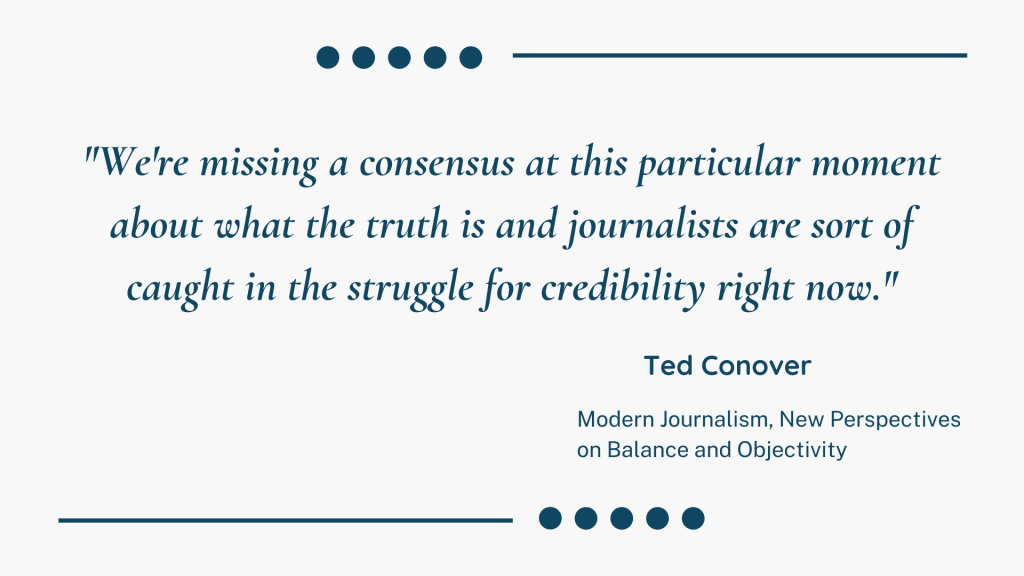
So we’re missing a consensus at this particular moment about what the truth is and journalists are sort of caught in the struggle for credibility right now.”
– Ted Conover, NYU Associate Professor11
Modern Journalism, New Perspectives on Objectivity (Yellowbrick)
~Forever Blessed


Read the previous article:


Further resources:
Photo Credits:
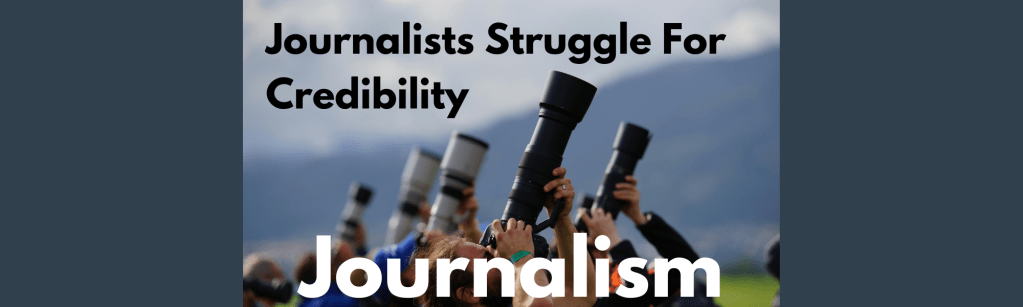
Cover Photo by René A. Da Rin: https://www.pexels.com/photo/people-holding-dslr-cameras-3695251/ , with edits by Erika Smith
- https://en.wikipedia.org/wiki/Alex_Jones ↩︎
- https://apnews.com/hub/alex-jones ↩︎
- https://www.bilderbergmeetings.org/ ↩︎
- https://www.the-independent.com/news/world/americas/us-election/trump-fake-news-counter-history-b732873.html ↩︎
- https://www.the-independent.com/news/world/americas/us-election/trump-fake-news-counter-history-b732873.html
“fake news” 1,906 times, according to transcripts and social media posts collected by Factba.se, as well as searches reviewed by The Independent. ↩︎ - https://www.mandourlaw.com/journalist-group-files-trademark-for-fakenews-so-trump-cant-use-it/ ↩︎
- https://www.youtube.com/watch?v=rnLmKoHPGm0 ↩︎
- https://www.hbo.com/movies/the-truth-vs-alex-jones ↩︎
- https://www.forbes.com/sites/bernardmarr/2024/08/28/the-ai-driven-truth-crisis/ ↩︎
- https://www.nytimes.com/2017/04/26/books/famous-misquotations.html ↩︎
- Modern Journalism, Acts of Journalism Today, New Perspectives on Balance and Objectivity, Lesson 14, Course 1 ↩︎
 Angle & Perspective
What’s your angle and perspective?