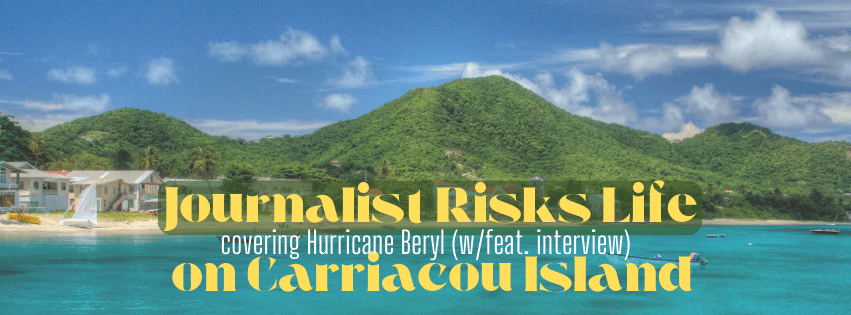
An interview with Journalist Jonathan Petramala, who survived a life-threatening event during Hurricane Beryl and found inspiration from local Carriacou islanders
The stories of journalists who put their lives on the line often go untold, but deserve much more recognition, appreciation, and memory for the news coverage they bring us that we would otherwise never know.
This is the story of one man who survived a life-threatening event when the roof of the safe house he was staying in blew off during his coverage of Hurricane Beryl. His visit not only brought much-needed attention to Carriacou after disastrous consequences to housing and infrastructure, but actually played a significant role in helping provide communications. He and his colleague were the only ones on the island with internet capability during the first few days. Despite the devastation to the small village, he was inspired by local Carriacou Islanders who touched him with their resilient smiles in the wake of complete and utter disaster the morning after Hurricane Beryl passed through.
Jonathan Petramala, was a broadcast journalist for over 20 years before deciding to carve out his own path as an independent documentarian storyteller. His passion is covering news related to extreme weather, the damage they cause and the lives they impact.
In the last year he’s covered extensive footage of the August wildfires of Lahaina, Maui, 1 and tracked weather from all directions in the US from a blizzard in West Coast California to a flashflood in East Coast Florida and several tornados and other natural disasters in between.2
As an extreme weather chaser, he is motivated by stories on the ground that give “attention to the power and resilience of the human spirit.”3
His most recent work has been focused on covering hurricane Beryl, its aftermath, and helping rebuild infrastructure on the Island of Carriacou through Rise Grenada4 and Carriacou Strong Relief Fund.5
Hurricane Beryl
On June 25th, a tropical wave left the west coast of Africa and by June 28th began rapidly intensifying in the Main Development Region (MDR) of the tropical Atlantic Ocean due to higher-than-average water surface temperatures. Normally storms don’t form in this region until mid-hurricane season, but Beryl broke several early records, including earliest Cat4 and Cat5 ever observed in the Atlantic Ocean. On July 1st, it hit the island of Carriacou in the Caribbean Sea as a Cat4 and by next morning returned to the sea becoming a Cat5 with peaked sustained winds of 165 mph (270 km/h). It continued through the Caribbean, slowing to a tropical storm over the Yucatan Peninsula, regaining to a Cat1 at landfall in Matagorda, TX on July 8th and dissipating as far Ontario, Canada by July 11th, leaving a trail of Tornadoes in 6 US states and Ontario. The storm caused massive damages, electrical outages, flooding and some casualties. Refs6,7
“Beryl marks the third year in a row there has been at least one Cat 5 Atlantic hurricane.”8

::] Interview ]::
[Angle and Perspective] Why did you make the choice to be on the island when the hurricane was coming through?
[ J. Petramala]
When we first got the [plane] tickets, it wasn’t even a hurricane. It was a tropical depression 2. But this year the way the atmosphere -and the way the water temperature in the oceans are- it is just a perfect recipe for a powerful hurricane. So, we knew all the ingredients were there for a powerful hurricane -still, we chose to fly to Grenada.*9
At the time. Jonathan and his colleage Brandon Clement (of WX Chasing) were watching weather predictions that suggested the storm would go north toward St. Vincent Island and felt they would be outside of the predicted path, but by Sunday -with predictions pointing toward Grenada- they had a tough choice to make … and the choice was to go.
[ J. Petramala ] “We took the last flight to Carriacou… and the moment, I remember the plane taking off after dropping us off, and just kind of that pit in your stomach because you know you’re in it; you’re going to be on the island no matter what with a major hurricane coming through.”
[Angle and Perspective]
Were the people there ready and prepared for what was coming?
[J. Petramala] “Not really. I mean…that part of the Atlantic, they’re actually not in what’s considered the hurricane belt… People, in part, couldn’t really believe that a big storm was coming, and then on the other hand -how do you prepare for something you’ve never seen before? You can’t really prepare for a category 3 or 4 or 5 (what you call a major hurricane) -you can’t prepare for a major hurricane if you’ve never been in one. It’s impossible. You can’t understand the power of it; and so a lot of people just were going with, “yeah, I mean, there’ll be a hurricane, but it’ll be okay tomorrow.”
[Angle and Perspective]
What was going through your mind when the roof started ripping off?
[J. Petramala] “We were in a hotel. Hotel Laurena, in Carriacou. We had two rooms. One was on the second floor where we had more shooting angles (so we could document the hurricane from a lot of different angles) and then we had a room downstairs. We had a lot to confirm from the very beginning that the roof on that second floor was going to go. We’d talked about leaving before the core of the storm came and it just never gave us a break. It was like there were no real strong winds…then all of the sudden it was like being hit by a slow-moving tornado. So, we just didn’t have the time.
[J. Petramala] I was out on the back patio … when you hear like a jet engine… giant pieces of roof flying over top of where I was shooting… I didn’t realize at the moment that that was our roof… So a couple minutes later… I went inside and look up and, “you know, we’re missing two thirds of our roof!” And at that moment, it’s pretty intense, because you dont’ have shelter, and there’s still parts of the roof that could collapse in …There were still large chunks of the roof that were strung inside the room.
Initially we were standing in the doorway of the bathroom, it was solid concrete so it kind of protected our heads a little bit. We tried to see if we could get the door open to go down to our bottom floor room but the pressure was so great we couldn’t open it, and eventually we retreated into the closet and rode it out. [We were] only in there about 15 minutes or so before the eye started to come in and the rains calmed down …It was not an ideal situation by any stretch. In a way, it’s ironic. It’s probably the most common story on the entire island of Carriacou -being in the house and having the roof ripped off right in front of you. The only difference is we actually recorded it. It’s definitely one of the most powerful hurricanes I’ve ever been in firsthand.
The following videos show footage of Jonathan’s plane leaving, an elder islander sharing his premonition and local TEK (traditional ecological knowledge) indicating warning signs of a big hit. The second video shows multiple homeless families sheltering together in a communal living situation (an occurrence that, I assure you, is going to involuntarily gain popularity in coming years). The second video also shows how Jonathan and Brandon unknowingly brought the only communication access the island would have in the immediate aftermath as they worked with the Prime Minister to help restore communications between different parts of the island via their Starlink.
Jonathan doesn’t chase storms to just cover the weather, he cares about the local impact on human life and shares stories of the people affected by these natural disasters. His humility and empathy go beyond his profession and show the world that being human comes first.
Angle and Perspective:
What’s the situation in Carriacou now?
[J. Petramala] “It’s slow… You can imagine… It’s a small island, so that’s good in a way, because there’s lots to do. It’s a town of like 9,000 people with new damage. When it comes to a hurricane that’s actually relatively low. It’s also very isolated and there aren’t a lot of easy ways to bring in materials.
[J Petramala] The people there are really incredible. They’re very kind. They’re unlike most places you’ll go in the world. And they really just need a chance and they’re not really quite there yet to getting that chance. They just need some raw materials and I think they could start the process a lot more quickly; the wood, the nails, screws, hammers -to get those raw materials so they can start using their own two hands to start rebuilding their homes.
[J. Petramala] There’s no real hotels for volunteers so whatever volunteers they do have, they come and leave a few hours later. So it’s a slow process, but for the most part they’re getting water and food. Now, they just really need those raw materials to start rebuilding.
[ Angle and Perspective ]
Out of all those displaced, where are people staying?
[J. Petramala] “It’s really a mish-mash. Some people are staying with neighbors, some with family members…I’ve seen a woman…her home was catastrophically damaged, knocked down to the foundation. The roof was ripped off, but she’s back in there with her kids…. Another couple whose home was completely demolished…it’s a concrete structure, but there’s like no doors, no windows, no furnishings…just a wall and a second story ceiling, so, they’re staying in a building like that.
Others are staying in a house where maybe half the roof is gone, [and are using tarps], so there’s a clock ticking on that. Then there’s the boaters… Because there’s a lot of cruisers (people from around the world who stay between the islands of the Carribean), there’s hundreds of boats damaged during the hurricane, so, some are homeless at this point, trying to make whatever repairs they can, because that’s their home. It’s a big problem. Even mansions… incredibly beautiful homes overlooking the ocean, the Carribean (gorgeous) -they were ripped to shreds. So, rich or poor doesn’t matter…hurricanes like Beryl come through and take everybody.
[ Angle and Perspective ]
What are some of the other sacrifices you’ve had to make?
[ J. Petramala ]
“There’s no food, no water, no air conditioning. There’s mosquitoes eating you that carry the Zika virus and Dengue fever, so it’s not what you would consider enjoyable. It’s not great conditions, but how else do we do it? We have to be there. We have to tell the stories, show the truth, show the reality.
The biggest blessing of being there was the fact that we had a Starlink and we were the only window to the entire world. There was no communication from the island, between governments even. We were the only way the whole world was able to see what had happened. And we did it at a speed that’s never really been done before either, because we had the technology that as soon as the storm was over, we were able to show images within hours of landfall. So, that really made a huge difference in terms of response. It sped up the process. Definitely by days, maybe even weeks, of where they are now in terms of recovering. And within two days, we had communications restored to the island by the Starlink that was sent in … Disaster response reached out to my partner Brandon and they were able to organize … 8 units of Starlinks and get them to the island to restore communications.
That’s the worst thing after a disaster: is reestablishing communication. If you don’t have communication you can’t organize water, you can’t organize food, you can’t organize anything, so getting that communication reestablished was a big deal.
Jonathan and Brandon were able to share their wifi with hundreds of locals, giving them the chance to make first contact with loved ones around the island or around the world who had seen the devastation and wanted to know if they were safe or even alive after not having a way to contact them. He said the appreciation in return was “so dramatic and so incredible.”
[ J. Petramala ] There was really incredible moments…[when] that first talk, that first word between family happened. It was a really special moment beyond just journalism. We were able to be humans first, right? We were able to understand and help from a human level and that was really special.
[ Angle and Perspective ]
What keeps you motivated to keep doing this kind of dangerous work that can often be exhausting, traumatic, and emotionally draining?
[ J. Petramala ] As an independent storyteller, I don’t have to ask permission to do something. I can be a human being. I don’t have some air of superioroity as a journalist. I can go in there and help people. The best way I can help is, of course, to tell stories, and to show the reality of the truth and share the truth.
But instances like that, where we can share our data, our wifi, and get people connected to the world…I mean, that’s priceless. And to organize Starlink, to organize the fast respsonse. We have so much experience with disasters, even more than most governments…we can use those skills and we can leverage them for people and that’s really what it’s about.
I can’t tell stories without people nor without empathy. And I get connected to these stories; I get connected to these people that I’m documenting and talk to and becoming friends with and you know, they’ll be lifelong friends.
All over the world. Covering stories of disasters, the worst usually brings out the best in people and so, I get a special look at that human nature and how good we can really be…and I’m lucky enough to call so many people friends, because of what I do.
I can share [the stories I hear in disaster] and it’s traumatic. It’s crazy how an entire island can just be mowed down by a hurricane, but that’s easily forgotten. What’s not easily forgotten is when you look at somebody in their eyes and they’re talking and they’re sharing their story -their stories of survival, stories of loss, stories of hope … And many of these folks on Carriacou were smiling. And if you look in the comments of these videos, people commented time and time again about how incredible the people are. “Wow, I can’t believe they’re still smiling. What incredibly bright, generous people these folks are.”
The majority of this world had never heard of Carriacou -I hadn’t until about two days before I went. When I shared the stories of the people they spoke for themselves…about just how special they are.
If you’d like to help the people of Carriacou, Grenada there are several ways you can do so. There are volunteer efforts (not listed) and the following to learn more or donate:
Rise Grenada
“On July 1st, Hurricane Beryl, a Category 4 storm, devastated northern Grenada and its sister islands of Carriacou and Petite Martinique, leaving no building untouched and destroying vital infrastructure. In response, Spice Island Marine, the sailing creator community, and a global group of creatives have joined forces to form RISE GRENADA. Join us in supporting the resilient spirit of Grenada and our sister islands by donating or volunteering today.” – RiseGrenada.org
Help the locals of Carraicou:
https://www.risegrenada.org/
GoFundMe for Carriacou Strong Hurricane Relief (help small businesses)
If you’d like to support Jonathan Petramala and his work you can follow these links:
Social Links to donate, support and follow Jonathan Petramala:
Facebook
Instagram
YouTube
X (Twitter)
Donate on Paypal
Thank you for making it to the end of this article! I hope you’ve learned some new and interesting things about the courageous, resilient people of Carriacou and about the dangers and hardships journalists like Jonathan Petramala face to bring stories and people together for us to see. Please consider leaving a comment on one of his social media platforms of support and encouragement!
Finally, since our conversation, Jonathan has released the full video documenting the most intense live-footage moments of surviving the roof peeling off from the winds of Hurricane Beryl (which you can view via his YouTube channel):
https://news.un.org/en/story/2024/07/1151811
If you’d like to see more stories like this one, please consider a donation using the link below or share your support or feedback in the comments below! Thank you!
Looking out for my fellow journalists from sunny-side-up Florida, and people around the world,
iam:ForeverBlessed
Angle and Perspective Journal


Photo credits:
Cover (modified by Erika Smith) – https://www.flickr.com/photos/lloydm/4738557082
- https://www.mauicounty.gov/CivicAlerts.aspx?AID=15840 ; https://en.wikipedia.org/wiki/2023_Hawaii_wildfires ↩︎
- https://www.youtube.com/@JonathanPetramala/videos ↩︎
- https://www.youtube.com/@JonathanPetramala/featured (bio/about section) ↩︎
- https://www.risegrenada.org/ ↩︎
- https://www.gofundme.com/f/carriacou-strong-hurricane-relief ↩︎
- https://www.weather.gov/lch/2024Beryl ↩︎
- https://en.wikipedia.org/wiki/Hurricane_Beryl ↩︎
- https://www.wunderground.com/article/storms/hurricane/news/2024-07-02-category-5-hurricane-history-atlantic-basin ↩︎
- *Quotations taken from interview conducted on July 30th, 2024 between Jonathan Petramala and Erika Smith ↩︎
 Angle & Perspective
What’s your angle and perspective?