Originally published 08.17.23
Class Inequality | Lifestyles | Poverty | Riches | Rich | Poor | Socioeconomic | Wealth | Wealth Distribution| Income | Households | Social Justice | Opportunity | Equality |
Journal Entry
Every so often in life you find a rare jewel that’s priceless. This week, I found one of those in a documentary by Jamie Johnson, heir to Johnson & Johnson family wealth. The documentary is titled: The One Percent, made in 2006. The idea behind the movie is simply a genuine attempt by Jamie Johnson to shed light on the elite world he is familiar with while exploring one he’s less familiar with. He hoped to help balance out the world by creating awareness and confronting issues of social inequality -not too dissimilar to what I’m trying to do, albeit in reverse.
A couple of months ago I shared a repost and added my thoughts, reflecting on my time at the hotel. From the upper-level floors of the Omni VIP Lounge, I watched homeless people on the street below while serving guests like Frank Sinatra Jr. (Lord, rest his soul) and other people of fame and wealth, treating each with as much respect and dignity as anyone else I would of human value. That’s the Omni way, but it’s also my personal way.
I spent a lot of time by the window when I didn’t have guests, because I had so much on my mind to reflect on and I guess looking out the window helped me think. I spent a lot of time looking at my own reflection, mostly looking past it to the world outside and in between. All the while using it as a mirror to spot guests or managers coming in behind me, so I could spring into action and be ready to serve and entertain before anyone had to time to wait.
I had a lot to think about as an expecting mother who was “wearing the pants” in the family since my terminally ill husband was medically restricted from working, and we were already barely getting by on my minimum-wage part-time job. I could only work so many hours being pregnant and with my own health conditions. The future looked really unpromising. Especially with a new political climate on the horizon…
Sometimes I’d be jolted out of my thought trance when the alarm on my phone went off, alerting me to put an additional $2 on the parking meter before I got “the boot.” (A literal car boot that is attached to your tire immobilizing it as a penalty for too many overstayed meter tickets). It happened more than once because sometimes I didn’t get to the meter in time. The $50-60+ to have it removed didn’t help. Co-workers were often exchanging dollars or coins for quarters.
This is what made my fascination with homeless people all the more relevant. Regardless of chatting it up on the couch with my millionaire and billionaire guests, dare I say friends in some cases, I knew I was really only one step away from being “like them” -those “good-for-nothing, worthless people” everyone ignores and is scared of being attacked by. I knew I’d never really end up “homeless,” because I have a large family, and someone or another would take me in if it came down to it, but it still gnawed at my psyche that that was the only real difference between me and them. After I lost my job due to being on bed rest, that’s exactly what happened.
What hurt me too was that I knew many of my other friends and family were in the same struggle, but no one wanted to talk about it. Everyone was pretending like everything was okay. Even after the COVID-19 pandemic, even as many more people have become homeless or are on the verge of it, still so few people are talking about money issues. I think mostly out of fear of no real solutions and the dreaded image/feeling of being less than. As mentioned in Jamie’s documentary, people have this idea that “This is just how it is.”
I was certainly never rich growing up, but I was still raised to be mindful of my money managing habits and I had very good credit built up before I moved out of my parents, but after I moved out I realized there were some things I hadn’t anticipated. It wasn’t long before I started to recognize the numbers for living weren’t adding up; and they still never have. But getting other people to see or admit how the numbers don’t add up has been an even more challenging battle.
My whole adult life has been a struggle regardless of “doing everything right” such as acing school grades and following on to college, getting a decent job, and out on my own. I had to give up my scholarship early on because I couldn’t manage full-time classes and full-time work. Since only one paid the bills, that decision was clear, but it was really painful to lose what I’d worked so hard for education-wise.
Staring out those hotel windows, I started imagining the darkness my son would be born into and desperate hope to somehow buffer him from experiencing the same struggles I had.
As Jamie Johnson, I started questioning a world beyond money-making. In short, this led me to places like the 12 Tribes commune where (more relevant to this article) there is no imbalance of inequality. Everyone shares everything in common. There are no rich or poor… and it works. It’s being done. It’s possible. And it’s all voluntary.
But being voluntary is exactly the crux of it. You can’t replicate a free heart, willing to give everything for the next person. You can’t buy it. You can’t sell it. It has to be free in order for it to work… and this is why it will never work worldwide. Too many people are complacent with being selfish, greedy, self-seeking, self-serving, self-motivated, self-interested. Too many people want to hold onto power, their “rights”, their destructive ideologies and their complacency to “continue as is.”
A free world is not possible where so many want to buy, sell and enslave the consciences of others and deceive themselves. I’m not saying that to be hopeless, but just realistic. Like I said, there are people who are living without inequality and I think it’s the best model we can hope for, but the reason it’s not more prevalent is because of the nature of human beings.
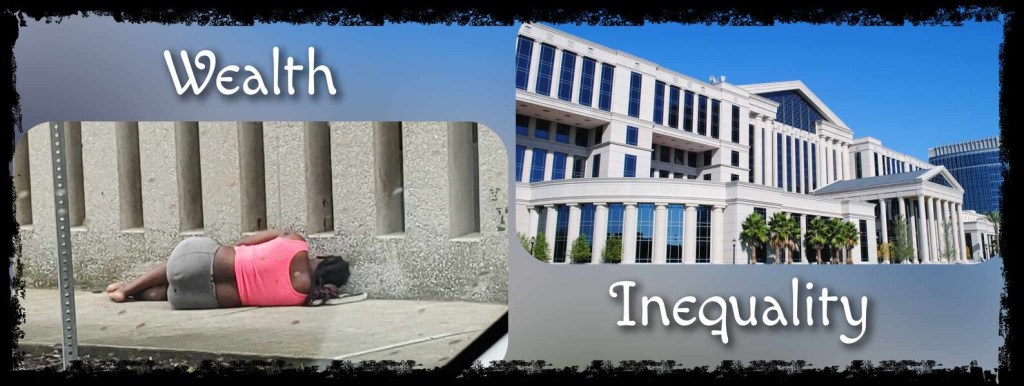
The picture on the cover of this article is a picture of a woman I saw when driving yesterday. She was just a few blocks behind the courthouse. When the courthouse was first being built I thought maybe the whitehouse was going to be relocated… I digress…
I’ve always had a soft spot for the homeless and “riff-raff” because of my Grandpa’s work in ministry …well, it didn’t have anything to do with his work. He just cared.
It doesn’t matter how well-to-do you are or how bad off you are. Both greed and charity are not partial to one’s level of class or income. A homeless person and a multi-billionaire can share the same level of greed in their hearts. So too, a homeless person and a multi-billionaire may share the same level of charity. It’s a matter of the heart, not of possession.
I’ve seen a lot of things in my life that have given me much to contemplate. I once worked for a very wealthy Dr. who wore holes in his socks, even after reprimand, because he didn’t care what other people thought of him and didn’t think he was too good to wear out his socks. I’ve seen a man in suit and tie driving a Mercedes-Benz without a dime in his pocket to even buy himself something to eat. I’ve had to listen to my co-worker talk about how he hates poor people, even though at max, he made $2 an hour more than I did on minimum wage. I had a millionaire offer me everything I wanted, but showed me that what I needed was a million times more valuable.
And more…
The documentary may be old news to some of you since it was made in 2006, but I was pretty surprised by it. I have a lot more to share about it and to say 😉 In the meantime, if you wish to watch it you can follow the link here:
The One Percent documentary by Jamie Johnson (YouTube)
Thoughtfully,
iam:ForeverBlessed
 Angle & Perspective
What’s your angle and perspective?