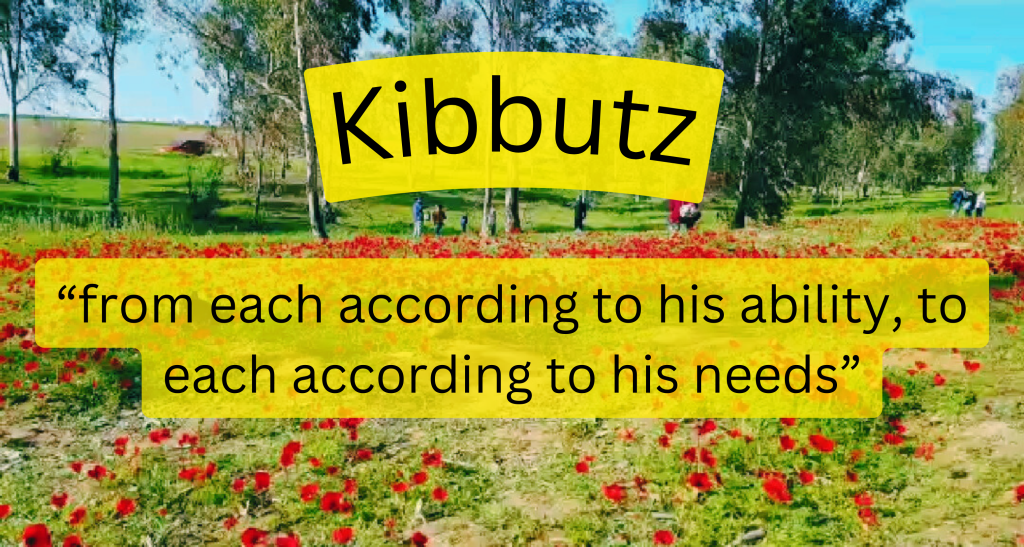
Kibbutz | Israel | Alternative Living | Intentional Community | Agriculture | Agrarian Society | Communal Living | Socialism | Communism | Co-operative Farming | Agricultural Cooperative | Social Issues | Social Solutions | Model Societies | Cultural Heritage | Climate Solutions | Sharing | Common Unity | Utopian Life | People Together | Co-Housing | Social Welfare | Environment | Childcare Solutions | Eldercare Solutions |
November 3rd, 2023
My heart goes out to the victims of recent attacks in Israeli Kibbutzim. Please know my prayers are with you and all who have been affected. Shalom.1
How would you like to live in a place where practically everything you need is handed to you on a golden platter?
No rent? No bills? Free health care? Free child care? Food and clothing provided?
Hmmm…Sounds too good to be true, doesn’t it? Okay, so, what’s the catch? There’s always a catch, isn’t there?
Well, believe it or not, I’ve stayed at a place like this and I think it’s a fantastic idea. In fact, for the life of me, I can’t figure out why the rest of the world doesn’t agree or hold the same level of enthusiasm for such a lifestyle…Although, there is a single word that seems to be the culprit of an otherwise tangible reality: cult. That single word can turn an innocent idea or long-standing community into a conjured nightmare waiting to happen…A world that you could unknowingly get sucked into and never return from… (dramatic emphasis mine)
Another word that derails any attempts to form such a place is “Socialism!” (uses an authoritative masculine tone for emphasis) “We here in America are NOT socialists or communists!”…(returns to normal feminine voice) It’s like…forbidden. You don’t want to be on the wrong side of the Democratic fence. However, polls show socialism is fairly trendy nowadays.
“A 2018 poll found that 43 percent of Americans have a positive view of socialism; an 18 percent increase from 1942 (Younis 2019). A 2019 poll found 55 percent of women prefer socialism to capitalism (Harris 2019). However, other polls reveal a decrease in the popularity of socialism among U.S. citizens, with few changes among Democrats and Republicans since 2010 (Newport 2018). Americans also disagree over the degree of socialism in America. A 2016 poll indicates that 54 percent of Republicans see America as becoming more socialist, while only 16 percent of Democrats agree (Investor’s Business Daily/TIPP 2016)…President Trump demonstrated this in his 2019 State of the Union Address, where he asserted “Here, in the United States, we are alarmed by new calls to adopt socialism in our country . . . Tonight, we renew our resolve that America will never be a socialist country.””1
So, socialist enthusiast or not, let’s at least forget the cult thing for a little bit and believe that this is a world where good things can happen outside of the prescribed narrative we’ve been told. Because a kibbutz really is as cool of a concept as it is fun to say (pronounced Kee-buhtz). It answers a lot of the social problems humanity faces and (as is also trending) offers solutions to the problems of “climate change” born as a collective, self-sustaining farming community. There have been changes through the years and some are more industrialized and not completely dependent on themselves, but on the larger community; still, the principles of sharing common goods and values remain.
Kibbutz means “gathering,” indicating the communal nature required for the agrarian settlements. There are multiple kibbutzim spread around the Holy Land, around 270 total.3 While communal living and agrarian society is a worldwide phenomenon, often organically inspired, Kibbutz or (plural) Kibbutzim are a Zionist idea intentionally dedicated to Zionist ideals. Degania (or Deganya) was the first kibbutz established in the Holy Land in 1909/1910, created by Zionist pioneers, Jewish Settlers from Europe seeking to create a Jewish state or homeland before the official declaration of 1948.4
“As envisioned by its founders, the kibbutz (or gathering, in Hebrew) was to be a utopian rural community, fusing egalitarian and communal ideals with those of Zionism and Jewish nationalism. In this voluntary collective community, Jewish newcomers would enjoy joint ownership of property, economic equality, and cooperation in production, and the maxim “from each according to his ability, to each according to his needs” would reign supreme.”5(Marx quote Ref6)
Degania Alef kibbutz has lasted for over 100 years and is still going today. Whether one is Zionist-approving or not, it stands as proof that these type of communal governments can be attainable and sustainable, with regard to adaptations and evolvement -in Israel’s case. For example, children are more likely to be raised by parents nowadays as opposed to child-rearing centers of the past, and apps are used to track and provide goods and services to members of more technologically accepting communes. The catch of course is that labor is required in exchange for goods, services, and especially residential membership (not a bad trade-off, in my opinion).
Not only members work on a kibbutz, but volunteers from all around the world. In the early days of Zionism, it was very popular for Jewish youth to make aliyah to Israel and volunteer to help grow the nation (bear in mind this was a more secular movement).
“In exchange for their work (often very hard work), kibbutz volunteers were given basic dorm accommodation, food, trips around Israel, parties and often a kibbutz pub at their disposal to take a break, let their hair down and mingle with the local kibbutz youngsters.
During the peak of the kibbutz volunteers phenomenon in the 1970s, around 12,000 volunteers arrived each year, and worked in hundreds of different kibbutzim throughout Israel. In total, more than 350,000 volunteers from 35 different countries have volunteered in various kibbutzim in Israel since 1967.
Some of the notable kibbutz volunteers include Jerry Seinfeld, Sacha Baron Cohen, Annie Leibovitz, Bob Dylan and many others.” – KibbutzVisit.com7
In current times, kibbutzim have lost favor with cooperating countries as the number of volunteers has declined over war escalations and have mostly been replaced by paid foreign employment.8 Most recently and notably, the Hamas attacks on Be’eri and other kibbutz in Southern Israel on October 7th, 2023.
Visiting a kibbutz is still possible. If you’d like to find out more (Click here)
Personal Insight:

I first heard of the kibbutz when browsing a book I had called, “Israel from the Air” by Itamar Grinberg quite a few years ago. A beautifully illustrated photography book showcasing aerial views of popular and lesser-known sites in Israel, Palestine, The Holy Land. At this time in my life, I was also very inspired by the land restoration achievements and innovations for agriculture improvements made. Even though my views on Zionism didn’t match those of political Zionists, I still very much admired the centralized structure of community around agricultural life and what would appear to be simplistic living. What appealed to me most about places like this were the environmental and social solutions it offered (and beyond this article, spiritual).
So a couple of years after my son was born, friends knew I was looking for a place like this and one of them helped us find the 12 Tribes commune where we have visited on multiple occasions and those stories will be featured in their own articles. Similar to the kibbutz, the 12 Tribes community lives mostly sustainably within themselves but is also dependent on larger society and accepts outside volunteers. They are US-based with International sites.
We’ve volunteered for less similar places as well. The biggest part of why I started my journal was to cover my travels, experiences, and exploration of other sustainable communities like these, so please let me know if you have any sites to share that we might consider visiting, speaking to members of, or getting ideas from. (Thanks!)
Some of the benefits to humanity and the environment of agrarian communal living:
(may or may not apply to modern kibbutz)
- Shared Transportation, Goods & Resources – means less waste, less pollution, more exchange, reuse/re-purposing/recycling, availability
- Housing Stability – housing may be shared but is pretty much guaranteed, shared housing and assets also mean less impact on climate resources and emissions9
- Local Food Security – less dependence on outside or foreign produce, less need for transport, environmental consciousness and land stewardship, nutritional retention
- Mental Health – more human interaction, socialization, and emotionally supportive environments
- Values/Conscience-Based Culture – members work towards common goals and are able to directly see the impact of their actions in the community
- Self-governance – members contribute and are held accountable within the rules of the commune, everyone has a voice and shares input to make decisions collectively. (In some cases, such as pioneer settlers, armed measures for self-protection were exercised as well.)
- Social Welfare – members’ needs such as healthcare are taken care of collectively easing the burden on individuals and families and are less likely to escalate to more complex conditions that can arise from neglect/access/affordability
- and more!
Reader Challenge: Would you live in or volunteer at a kibbutz or commune? Why or why not? Have you before? What are your thoughts? Please Share in the comments section below!
Did you enjoy this article or find it insightful? Please give a like and share!
Shalom, blessings and peace!
iam:ForeverBlessed
The Spielberg Jewish Film Archive – A Day in Degania
Could you live this way? (Israeli Kibbutz Communal Living)
“I would say they are considered one of the most successful experiments in voluntary socialism,” said Ran Abramitzky, a professor of economics at Stanford University. “Jewish immigrants who founded kibbutzim rejected capitalism and wanted to form a more socialist society.” (REF)
Further Reading and Exploration:
https://search.ontariojewisharchives.org/Permalink/landmarks253
Photo Credits: Cover – https://en.wikipedia.org/wiki/File:Be%27eri,_Israel,_2019.jpg
1https://journals.sagepub.com/doi/10.1177/10659129211037402?icid=int.sj-full-text.citing-articles.113#:~:text=A%202018%20poll%20found%20that%2043%20percent%20of%20Americans%20have%20a%20positive%20view%20of%20socialism%3B%20an%2018%20percent%20increase%20from%201942%20(Younis%202019).%20A%202019%20poll%20found%2055%20percent%20of%20women%20prefer%20socialism%20to%20capitalism%20(Harris%202019).
2https://en.wikipedia.org/wiki/Kvutza
3https://www.npr.org/2023/10/12/1205284601/what-is-a-kibbutz-the-roots-of-israels-communal-villages-where-violence-raged#:~:text=There%20are%20about%20270%20kibbutzim,on%20modern%20industry%20and%20tourism.
4https://www.gov.il/en/departments/general/declaration-of-establishment-state-of-israel
5https://jacobin.com/2016/10/kibbutz-labor-zionism-bernie-sanders-ben-gurion/#:~:text=As%20envisioned%20by,would%20reign%20supreme.
6https://www.marxists.org/archive/marx/works/1875/gotha/ch01.htm#:~:text=From%20each%20according%20to%20his%20ability%2C%20to%20each%20according%20to%20his%20needs!
7https://www.kibbutzvisit.com/volunteer-on-a-kibbutz/#:~:text=In%20exchange%20for,and%20many%20others.
8https://www.kibbutzvisit.com/volunteer-on-a-kibbutz/#:~:text=During%20the%20last,of%20foreign%20workers.
9https://www.aspeninstitute.org/blog-posts/the-devastating-effects-of-climate-change-on-us-housing-security/
 Angle & Perspective

What’s your angle and perspective?