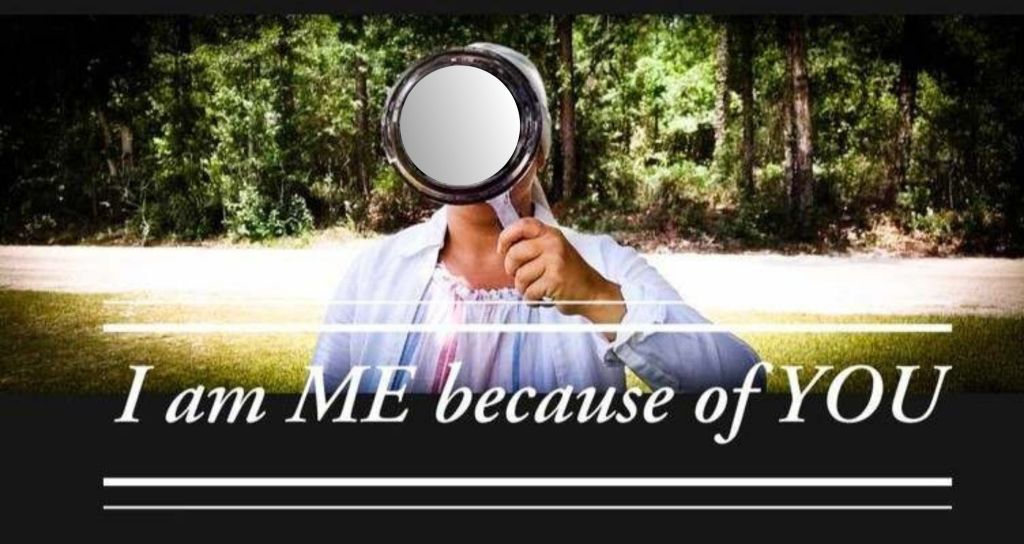
Shifting Independent Identity to Relational-Identity
Angle & Perspective – Journal
{Opinion, Informative, Personal Stories, Reader Challenges}
Originally published May 15, 2023
| Identity | Inter-dependence | Inter-connectedness | Loneliness | Hyper-individualism | Mental Health | Social Skills | Relationships | Collective Identity | Culture | Society | Sociology | Personal development | Diversity | Inclusivity | Community | Tribalism | Hive Mind | Indigenous Knowledge | Environments | Strengths | Weaknesses | Boundaries | Communication | Interaction | Solidarity | Challenges | Friendship | Appreciation | Conscious Lifestyles | Faithfulness | Commitments | Faith | Support | Gratitude |
Interconnected Series
Who we are does not just come from within ourselves. Our parents shape us, society shapes us, culture shapes us, environments shape us and our consciences shape us. – Forever Blessed
What does it take to flip the “M” in Me to a “W” for We?
Last night we watched the movie “Sherlock Gnomes” and I think I just solved the riddle of how I can work this story into my article…because the message conveyed was whether self-absorption was worth the cost of one’s most faithful partners in life -in this case: Gnomeo and Juliet or Sherlock Holmes and his faithful assistant Watson. (Spoiler alert:) Both sets have taken each other for granted, but Watson, as a desperate last attempt to prove how aloof1 Sherlock is from seeing his own folly, sends him wildly chasing after signature “M” clues disguising his truth behind Sherlock’s obsession with his past enemy Moriarty, until the final clue is revealed as not an M but, in fact, a W for Watson. In the end… Well, I won’t spoil the whole thing, just watch it. It’s cute. Moral of the story is whether living separate individual lives (the “me”) is more preferred than going at life together (the “we”).
Gnomeo and Juliet (currently free with ads on Amazon prime)
On with the article…
Have we, as a culture, become too obsessed with self-interest and self-absorption? It’s important to know who we are at our core being, what makes us the unique individuals that we are -to have some sense of Self. There’s something different about each of us that distinguishes us from one another. We’re very familiar with our independent identities, but what about our inter-dependent or collective identities? Who we are in light of the other people, places, times and environments in our lives? In this article, I’ll mostly stick with people-related influences. How powerful a role do others play in shaping our “independent” selves and our identities?
Inter-dependency – the delicate balance between dependency and independence – is the hallmark of emotionally intimate relationships. [lost source, my apologies, will update when found…]
“I just gotta be me” has been the battle cry of the last several individualistic generations… I think it’s obvious to all sentient 21st-century beings that several generations of this self-centered mentality have come back to bite us…I think that people of all political persuasions are finally admitting that we need to get along, and consider others in order for civilization to survive.” (Euny Hong, The Power of Nunchi, pg. 139 & 1402)
The movement to “know thyself” comes at a price as people set out on a journey of self-discovery and self-awareness. People are finding themselves less familiar with the modern world we are part of and seek to identify themselves in light of globalization and a society geared by economic, social, technological advancement and so on. But seeking to identify oneself is part of asking the age-old questions of, “Who are we”? Or “Who am I?” and “Where did we come from?”. The price comes as we seek to identify ourselves primarily by ourselves.
Let another man praise thee, and not thine own mouth; a stranger, and not thine own lips.
-Proverbs 27:2 (KJV)3
He that is first in his own cause seemeth just; but his neighbour cometh and searcheth him.
-Proverbs 18:17 (KJV)4
Aeon.co article excerpt:
“We all have fairly stable ideas about what kind of people we are…..There is, however, a deep problem with this mental set-up: people change. There are tumultuous periods when we change drastically – in times of romantic love, say, or divorce, or having children. Often we are aware of these changes. After you’ve had kids, you probably notice that you’ve suddenly become a morning person…..We are exceptionally good at dismissing even the possibility that we might change. Psychologists have given this phenomenon a fancy name: ‘The End of History Illusion’. We all think that who we are now is the finished product: we will be the same in five, 10, 20 years. But, as these psychologists found, this is completely delusional – our preferences and values will be very different already in the not-so-distant future.” – (‘Know thyself’ is not just silly advice: it’s actively dangerous -article by Bence Nanay, Prof of Philosophy at University of Antwerp in Belgium) 5
You see, just when we think we’ve figured out who we are…someone else might beg to differ. You might think you’re the worst at something until someone else says and convinces you otherwise. One country might think they are the best country in the world, while another completely disagrees. Who is right or wrong? Or is trying to figure out who’s right or wrong the wrong question to begin with? ‘Why does one country feel the need to be better than another?’ -might be a better question to address the issue of human nature. Why does one person need to be better than another? Shouldn’t we all seek to help each other rise to the same greatness? I digress… but the point is that others can be a valuable source of input and feedback to help keep us in check with our own egos and help us to grow and develop.
King David’s wisdom was echoed by his son Solomon in the verses teaching “the fear of the Lord is the beginning of wisdom.”6 Socrotes taught that “to know thyself is the beginning of wisdom.” And so two schools of thought provoke each other.
The fear of the Lord can be understood for purposes here as recognition of a Creator, as in Native culture, something greater and higher than ourselves that we have to answer to; that says we are bound to live within the laws of nature and the universe, not just by our own self-imposed standards.
“Know thyself” is an Ancient Greek aphorism. According to the Greek writer Pausanias, it was the first of three Delphic maxims inscribed in the forecourt of the Temple of Apollo at Delphi.7 – Wikipedia
In my life at least, there’s been this clash between Western and Eastern mindset ever at odds with each other. Our American culture seems to have embraced what has been coined now as “hyper-individualsim”8 while attempting to avoid at all costs the collective socialism9 practiced in Asian cultures like China, Vietnam & India.10 Western mindset has dominated American culture but in recent years, some progress is being made to appreciate facets of the Eastern mindset a little more.
“Korean culture values seeing oneself as part of a larger organism…[having Confucian roots]…based on the belief that every member serves a role that interlocks with everyone else.” (The Power of Nunchi, Chapter 7, pg. 138)
This mindset is much more akin to the Biblical teachings of a church being a “body of members.” We still use this word, “members,” in our culture to embody people who are part of a group, cabinet, organization, etc., but maybe it’s lost some meaning along the way. There’s a union of fellowship that requires some sacrifice of oneself for the good of all.
Each member has something different to bring to the group just as a hand functions differently than a foot for different purposes, but each work in cooperation with each other and are appreciated for their own strengths. If someone is blind, their other member senses (heightened senses of hearing, touch, etc.) are required to help navigate the body in ways that might require more effort than normal.
“And whether one member suffer, all the members suffer with it; or one member be honoured, all the members rejoice with it.” 1 Corinthians 12:2611
In this mindset, people are more likely to look out for each other and breed inclusivity.
1st Personal insight:
>>Personally, this is how I came to cover topics like these. I’ve had a hard time reconciling my faith with an individualistic mindset and lifestyle, but I’ve found the culture at large is suffering in many ways from the impacts of self-centered ideals…to divorce rates to birth rates and nearly every area of social infrastructure. As a result, I’ve discovered people who walk contrary to mainstream culture and I’ve found their lives fascinating and deeply enriching. In my own life, connecting with others who share similar values and ideals has created hope and inspiration that I hope to pass on to others. They’re also teaching me to have a greater appreciation for community, togetherness and interdependence. <<
Author Jillian Straus (former producer for The Oprah Winfrey Show and ABC News, & founder of Straus Strategic Communications) in trying to understand how we got to this place of disconnect in relationships, specifically in reference to singles struggling to find marriage, lists a number of “evil influences” in the book Unhooked Generation:
“Evil Influence #1: The Cult of I
A number of people I interviewed found themselves unhappily single long after they experienced all the things on their to-do lists…..[and said] deep commitment might impair their self-oriented, care-free lifestyles or cause them simply to make compromises. Many of my unhooked singles wanted to “do their own thing” and expected love to come without too much personal sacrifice. This is fine if you are happy to remain single, but if you want intimacy, this won’t work.”12 (Unhooked Generation: The Truth About Why We’re Still Single, pgs. 16 & 17)
“Psychologists have discovered that a healthy personal identity can form only in the midst of healthy relationships. “We have both an internal, embodied identity as ‘me’ and an interpersonal, interconnected identity as ‘we’”, explains psychiatrist Daniel Siegel. “Both me and we shape our sense of self.” In other words, people are predisposed to define themselves through their relationships, a process that starts at birth. On the other hand, unhealthy or dysfunctional relationships can cause a host of psychological problems, most of them related to identity and a chlid’s ability to relate to others.” –Understanding family and personal relationships by Christine Wilcox, pg.6 (youth book)
As independent individuals, we like to think we’ve gotten so far on our own, but in reality, we rarely get anywhere alone. We probably didn’t finish school alone (teachers, bus drivers, tutors) or become a multi-million-dollar CEO alone (investors, partners, customers, workers). We certainly didn’t come into this world alone. It took at least two people and this is the model of ideal circumstances and the foundation of society: a family, multiplied continuously. Without the family, society doesn’t exist, so when we become so focused on individualism that we neglect the value of family as a culture, we are dooming ourselves.
It’s tricky because the U.S. and native nations have such completely different worldviews. But, to a large degree, native nations look at the health of the community at large. Every person needs to be as productive as they can be, and needs to be spiritually and physically healthy to achieve that. -Jeff Means, Ogala Sioux, MilitaryTimes.com article13
“Indigenous peoples are inheritors and practitioners of unique cultures and ways relating to people and environment. They have retained social, cultural, economic and political characteristics that are distinct from those of the dominant societies in which they live.” (Climate Change and Indigenous Peoples and Communities course material, Universitat Autònoma de Barcelona) Link to free course
We’ve had in our American backyard a wealth of more socially inclined cultures and environmentally friendly knowledge from such and this is a pivotal point in history where we can take our Native heritage for granted, and Natives can take European development for granted, or maybe like Sherlock and Watson or Gnomeo and Juliet we can find opportunities to work together and appreciate one another.
Author David Brooks suggests we don’t need to go back to tribalism to counter hyper-individualism, but can settle in the middle with relational-identity.
There is always a balance between self and society. In some ages, the pressures of the group become stifling and crush the self, and individuals feel a desperate need to break free and express their individuality. In our age, by contrast, the self is inflated and the collective is weak. We have swung too far in the direction of individualism…..Hyper-individualism leads to tribalism. People eventually rebel against the isolation and meaninglessness…by joining a partisan tribe. This seems like relation but is actually opposite. If the relationalist mentality is based on mutual affection, the tribalist mentality is based on mutual distrust. It is always us versus them, friend or enemy, destroy or be destroyed…..Relationalism is a middle way between hyper-individualism and collectivism. The former detaches the person from all deep connection. The latter obliterates the person within the group, and sees groups as faceless herds. The relationalist sees each person as a node in a thick and enchanted web of warm commitments. She seeks to build a neighborhood, nation, and world of diverse and creative people who have made commitments in a flowering of different ways, who are nonetheless bound together by sacred chords. (The Second Mountain: The Quest for a Moral Life, chapter 25, pgs. 297 & 301)
While I think the phrase “the tribalist mentality is based on mutual distrust” could be considered offensive (to myself & my native tribespeople & indigenous tribes in general), I do understand what David Brooks means.
We are seeing groups/tribes of people band together over extremist views or deviant fads for the worst and this pattern will continue until the real needs of our society at large are addressed and changed (which starts with you! ;)). I also understand it in the context of the smaller communities and villages I’ve come across that I plan to cover in future articles & this may be why I haven’t been able to come to terms with long-term commitment to any, but I’m still open-minded. A middle ground definitely seems like a good place.
2nd Personal insight: I started discovering my relational identity after reflecting on the impact of leaving a particular religious group I was part of, new relations, readopting aspects of my Native American heritage, spending time in isolation, as well as all of the times I moved locations… or even old ideas left behind in favor and adoption of new less familiar places in physical or mental space; observations of others and observations on the influences culture and environment play on our identities.
I feel like I’ve become more grateful as a result of adopting the inter-dependence mentality. I have more appreciation for who I’ve become as a result of who’s been part of my life. I’ve kind of always been this way, but now with a greater appreciation for the groups and cultures I’ve grown in or outside influences I’ve been exposed to and learned from. I savor connections more. I value the ideas in this article and look forward to expanding my experience and knowledge of them. I’ve been trying to formulate these ideas on my own but in the past year have come across several books (such as the ones mentioned in this article), communities and social media influencers who are breaking the same ground. If you have more sources you’d like to contribute, or your own thoughts, please share away! Happy to learn from you.
Reader Challenge:
Are you growing? Growth happens in times of isolation and also in times of social interaction through edification or challenge posed by others (like my challenge here! :-D). If you’ve spent a lot of time growing in isolation, it might be time to put yourself out there a little more. In reverse, if you’re the type of person that never likes being alone, you may need to spend a little time there to come to terms with why you feel so dependent on others presence to comfort you and discover who you are apart from so much external influence. Everything balanced and in moderation. If you need further suggestions or want to connect to discuss relational content, you’re welcome to >>>connect with me<<<.
Meditation, Reflection & Giving:
Take some time to think about who and what has had an impact on your own identity and reflect on your sense of relation to others. Consider taking some time to reach out to those you’re grateful to and let them know how they’ve changed you or made a positive difference in your life. Reflect on how you’re contributing to the lives of others and if you’re happy with your conscience or if some things need a little work.
If you like the ideas presented here, let me know!
If you think these ideas are worth spreading, share the link in your feed or send it directly to others!
Which would you rather say? “I did this on my own” or “We did this together”?
Thank you,
Stay blessed & connected!
iam: ForeverBlessed
 Angle & Perspective
What’s your angle and perspective?